BPMN
Why agentic AI is making BPMN mainstream again

Robbert Schuurmans
Process Innovation
For a decade, BPMN was a specialist's language. Business analysts loved it. Almost nobody else opened the files. That is changing fast, and the reason is not a modelling renaissance. It is agents.
Once you let software act on its own, someone has to define exactly what it is allowed to do. BPMN automation turns out to be the most practical answer we already have. A notation that felt like documentation overhead is quietly becoming infrastructure.
Agents need a definition they can read
An agent that answers questions needs context. An agent that acts, that issues a refund or files a claim, needs boundaries.
Those boundaries have to live somewhere explicit. A prompt is not enough, for three reasons:
Prompts are not auditable. You cannot show a regulator a paragraph and call it a control.
Prompts drift. Change the wording, change the behaviour, with nothing to diff.
Prompts do not compose. Two agents sharing a handover need a shared definition, not two descriptions.
A BPMN 2.0 model is none of those things. It is explicit, machine-readable, versionable and standardised. You can diff it. You can point at the exact gateway where a decision happens.
Why the standard matters more than the diagram
The appeal here is not that the notation is pretty. It is that BPMN is a specification, maintained by the OMG, with defined execution semantics.
That last part is the whole argument. A flowchart drawn in a slide deck means whatever the reader thinks it means. A BPMN model has rules. It defines what a parallel gateway does, what an error boundary event catches, and how a failed path behaves. Those rules are what let a runtime, or an agent, behave predictably.
So the question stops being "should we document this process" and becomes "what is the contract this agent operates under". New to the notation? Start with what BPMN is, then read up on gateways, because gateways are where most guardrails actually live.
Where BPMN becomes the bottleneck
Here is the catch, and it is a real one.
Every agent needs a process definition. If each definition takes three weeks of interviews and drawing, modelling becomes the constraint. It now stands between you and every automation on your roadmap. Teams hit this within a quarter of starting. The pattern is predictable:
The first two processes get modelled properly, by your best analyst.
The next fifteen get "documented" in a wiki page, because there is no capacity.
Six months later nobody knows which definition the agent is actually running against.
That is not a modelling failure. It is a throughput failure. The standard is fine. The production rate is the problem.
How to keep it from becoming one
The fix is a change in category. Stop treating a process model as an artefact you commission. Treat it as an output you generate.
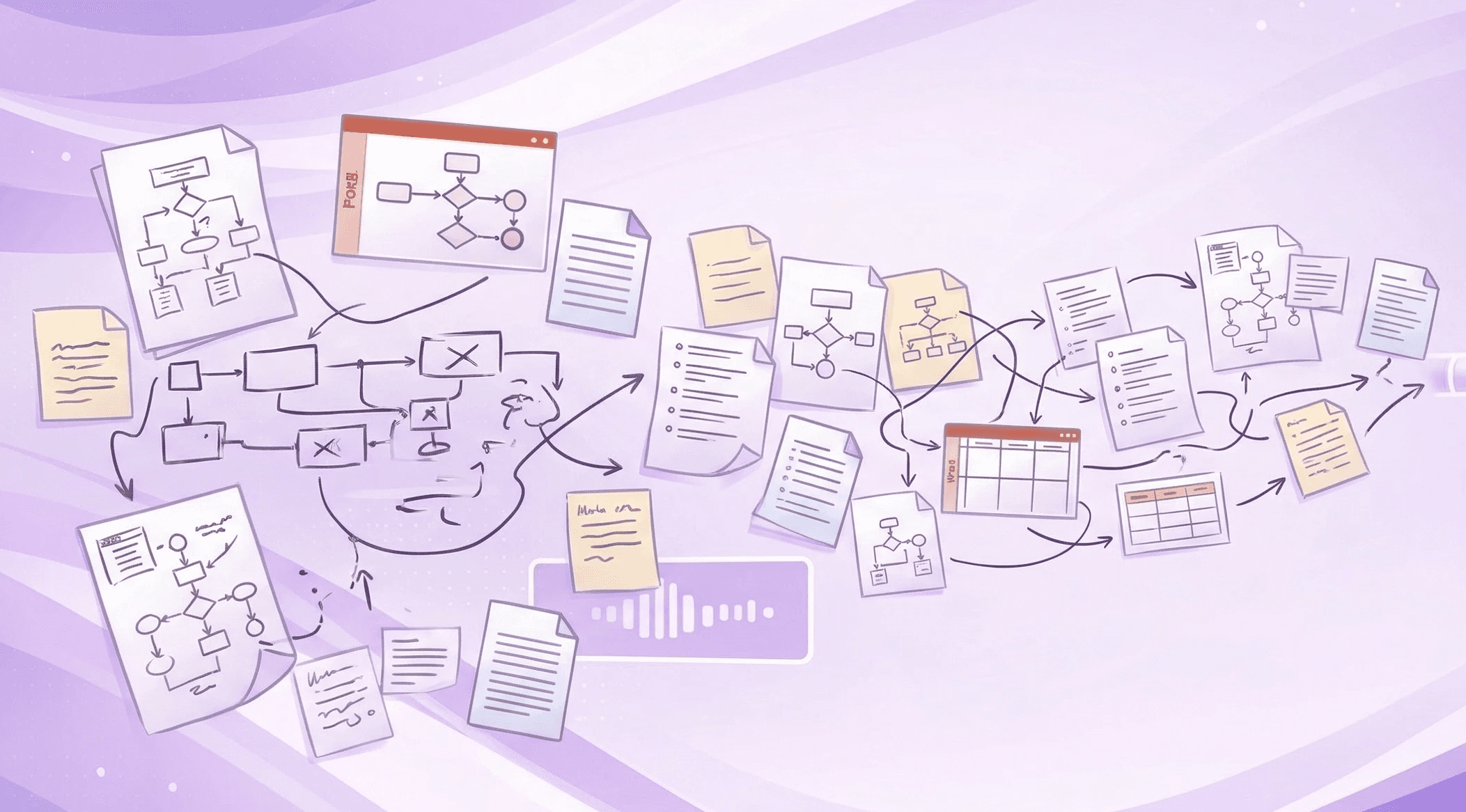
That means shortening the loop from conversation to model. With ModelMatic the input is what you already have. Feed in the interview recording, the transcript or the existing procedure document. A validated BPMN 2.0 model comes out. Stakeholders then correct a diagram instead of reviewing prose, which is a far faster kind of feedback.
A few habits help more than any tool:
Model the exception paths first. That is where agents cause damage, not the happy path.
Version models like code. If you cannot diff it, you cannot govern it.
Keep one notation. Mixed notations across teams reintroduce exactly the ambiguity you were avoiding.
What this means for the next two years
Expect BPMN literacy to spread well past the analyst community. Not because people suddenly love notation, but because the alternative is autonomous software with undocumented boundaries. Governance teams will start asking for process models the way they already ask for access logs.
The organisations that handle this well will not be the ones with the most modellers. They will be the ones who made modelling cheap enough to keep current.
Curious what that looks like on your own process? Book a demo and bring one recorded interview.