AI & Process Discovery
How to accelerate process discovery without cutting corners

Simon Parmet
Process Innovation
Every consultancy sells insight and bills time. Process discovery is where those two things fight each other. The client pays for weeks of interviews and drawing, then waits for a deliverable they cannot yet judge. Nobody enjoys that phase.
Speeding it up is not about working longer hours. It is about removing the steps that create no insight. Here is the playbook we see working, split into four changes you can make without touching your methodology.
Where discovery time actually goes
Audit a recent engagement honestly and the split usually looks like this:
15% talking to people. The part clients value, and the part that generates the insight.
55% writing up and drawing. Transcribing, structuring, redrawing in a modelling tool.
20% correction rounds. Because the first model always misreads something.
10% reformatting. Making it match the client's template or notation.
Only the first slice is analysis. The rest is production. Yet the production work is what sets your delivery timeline, and it scales linearly with the number of processes. That is why discovery gets scoped down rather than sped up.
Step 1: Stop treating the interview as raw material
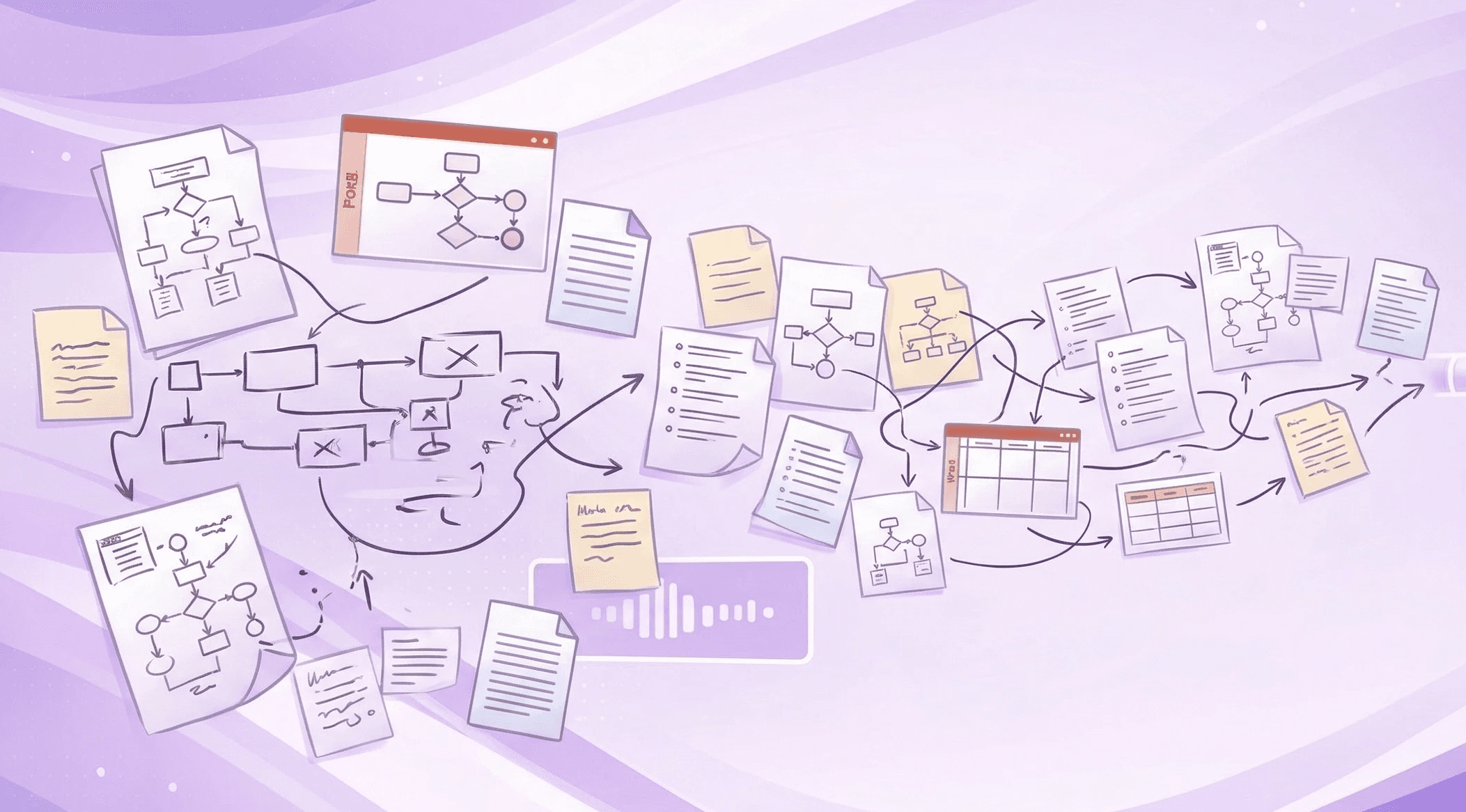
Most teams treat the interview as an input to be processed later. The consultant listens, takes notes, then reconstructs the process days afterwards from memory and a transcript.
That reconstruction gap is expensive. Detail decays, ambiguity gets resolved by guessing, and the interviewee is no longer around to ask. Every hour between the conversation and the model adds correction rounds later.
Treat the recording as the artefact instead. It already contains the process. The job is extraction, not reconstruction.
Step 2: Model in the room, not after it
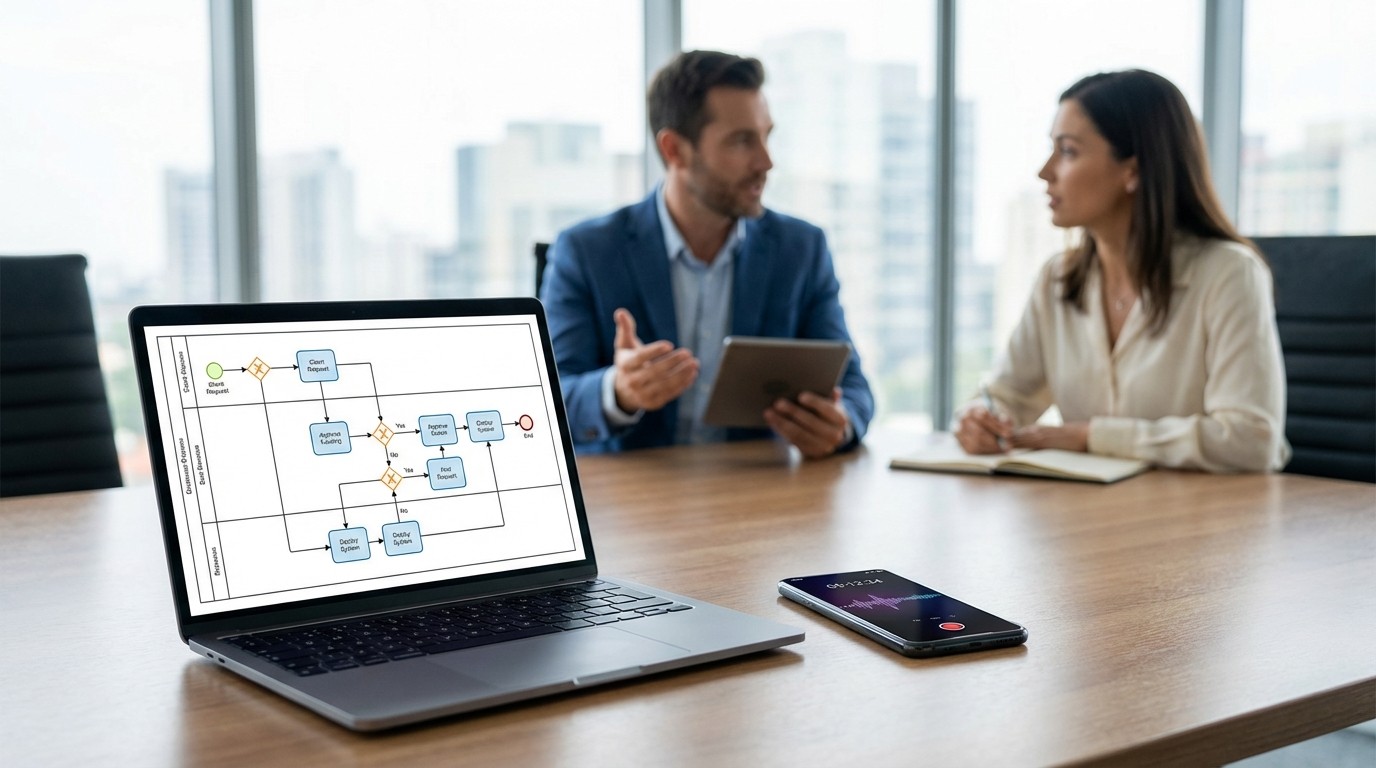
The biggest single change is producing a first model while the stakeholder is still available.
When a draft model exists during the session, the conversation changes shape:
Corrections happen live, at the moment they cost nothing.
Stakeholders point at a picture instead of reading prose they will skim.
Exception paths surface immediately, because seeing a happy path prompts "but what if".
Sign-off starts earlier, which is usually the real critical path.
This is what ModelMatic is built for. It turns an interview, transcript or existing document into a validated BPMN 2.0 model. Fast enough to review in the same session.
Step 3: Standardise notation before you scale the team
Speed dies quietly when five consultants each model in their own dialect. Reviews slow down, quality varies by who staffed the project, and the client inherits a library they cannot maintain.
Pick one standard and hold it. BPMN 2.0 is the pragmatic choice because it is vendor-neutral and your clients' tooling already reads it. Is your team uneven on the notation? Our guides on what BPMN is and BPMN gateways make a decent shared baseline.
Standardisation is also what makes the next step possible.
Step 4: Make the second engagement cheaper than the first
Consultancies rarely capture reuse. Each engagement starts from a blank canvas. That happens even when the process is the same claims handling flow you modelled twice last year.
A consistent notation plus a fast production loop lets you build a reference library. Not to hand clients a generic template. The point is to start from a structured hypothesis, then spend the interview validating rather than excavating. That single shift compresses discovery more than any other change on this list.
What this does to your margin
The arithmetic is straightforward. Production work is 75% of discovery. Compress it substantially and you can do one of three things. Finish sooner, cover more processes for the same fee, or move consultants onto analysis and advice.
The third option is usually the most valuable. Clients do not remember who drew the diagrams. They remember who told them which process to fix. Our case studies show what that looks like in practice.
Wondering which tooling fits your workflow? We compared the options in the best tools to automate process discovery. Or book a demo and bring one real client recording.