AI & Process Discovery
Best tool to automate process discovery in 2026

Simon Parmet

Best tool to automate process discovery in 2026
The hidden cost of manual process modeling
Last week, I spoke with a business consultant who’d spent three days drawing BPMN diagrams from a single workshop transcript. By day two, she’d realized the stakeholders had contradicted themselves twice, and she’d built half the process model on the wrong assumptions. Sound familiar?
This isn’t a skills problem. It’s a volume problem. According to a 2026 report by ProcessMind, 70% of manufacturers have automated 50% or less of their core operations, and one of the biggest bottlenecks is the time analysts spend turning messy interviews, scattered emails, and half-finished Word documents into standardized BPMN diagrams.
The good news? AI-driven process discovery tools are finally solving this. Let’s walk through what’s actually working in 2026.
What process discovery automation actually means
Process discovery is the act of mapping out how work gets done, capturing the steps, decisions, handoffs, and exceptions that make up a business process. Traditionally, this meant:
Conducting stakeholder interviews (often 3-5 per process)
Reviewing existing documentation (if it exists)
Manually drafting a BPMN diagram in tools like Visio or Lucidchart
Validating the model with stakeholders (and repeating when they say “that’s not quite right”)
According to a 2025 study by BA Times, this manual approach creates what they call “process debt”: incomplete, inconsistent documentation that forces analysts to spend more time fixing old models than building new ones.
Automated process discovery flips this. Instead of drawing diagrams by hand, you feed raw inputs (recorded conversations, text documents, even system logs) into a tool, and it generates a BPMN 2.0 diagram automatically. Teams using these tools report turnaround times of 2-4 weeks instead of months, according to KYP.ai’s 2026 benchmarking data.
Why BPMN 2.0 standardization matters
BPMN (Business Process Model and Notation) 2.0 is the global standard maintained by the Object Management Group. It’s not just another diagramming format. It’s a structured, executable notation that bridges the gap between business analysts and technical teams.
Here’s why that matters:
Common language: A BPMN diagram means the same thing to a process analyst in Utrecht and a developer in Mumbai. No interpretation needed.
Tool interoperability: BPMN 2.0 files can be imported into platforms like SAP Signavio, Bizzdesign, Blue Dolphin, and Camunda without conversion or data loss.
Execution-ready: Modern BPM platforms can directly execute BPMN models, turning your diagram into a running workflow.
When your process documentation isn’t standardized, you end up with fragmented deliverables: flowcharts in PowerPoint, swimlane diagrams in Draw.io, and custom visuals that nobody outside your team can use. According to Bizagi, standardizing on BPMN allows organizations to “document processes in a unified way so that everyone in an organization can understand each other.”
The automation challenge: from messy inputs to clean diagrams
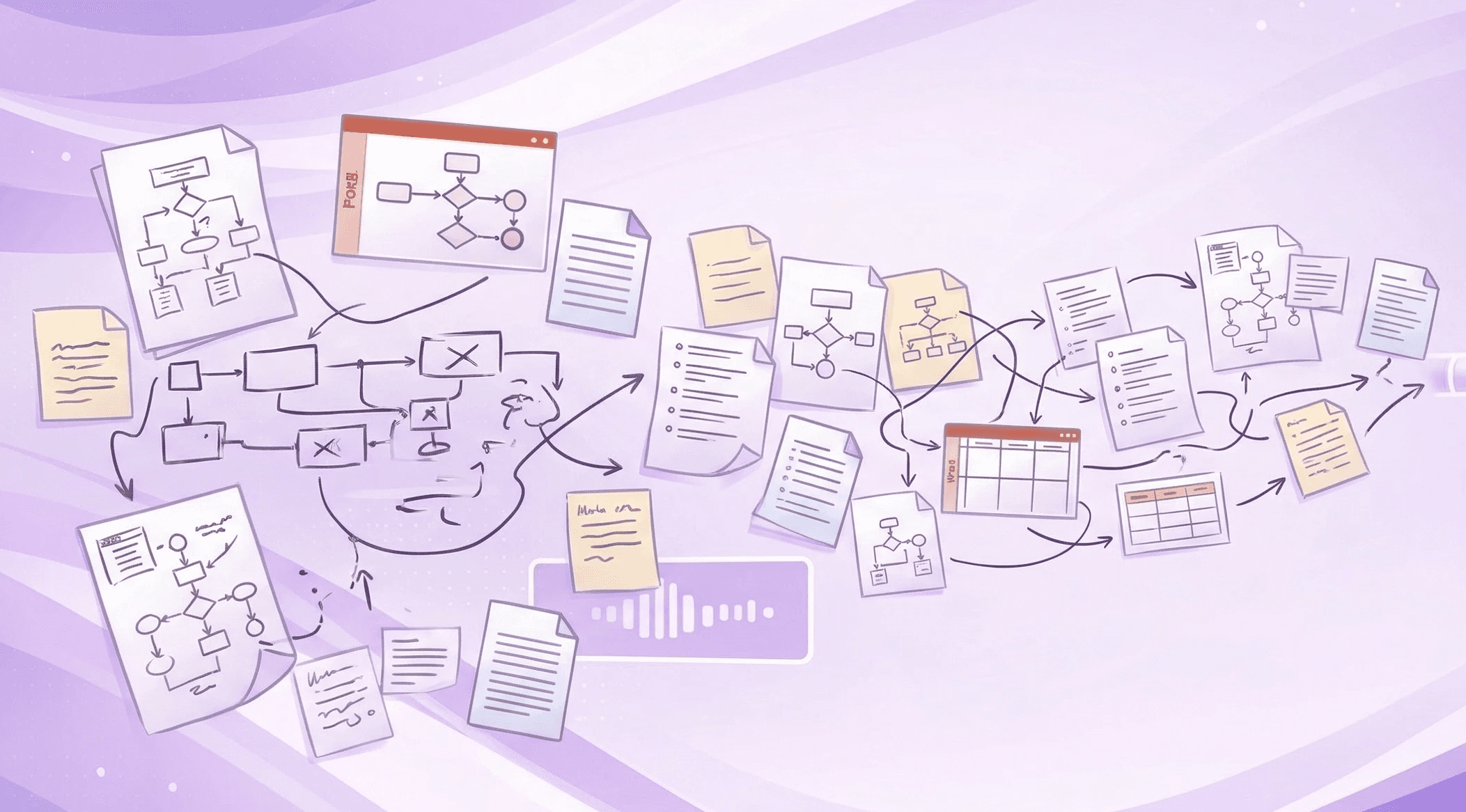
The real challenge isn’t drawing boxes and arrows. It’s interpreting the mess.
Here’s what “messy documentation” looks like in practice:
A 45-minute stakeholder interview where the process owner uses different terms for the same step (“approval,” “sign-off,” “validation”)
A Word document with bullet points, nested sub-bullets, and tangents about edge cases
Email threads where three people describe the same workflow in three different ways
Meeting notes that capture “what” happens but not “who” does it or “when”
Traditional diagramming tools (Lucidchart, Visio, Miro) are great once you know what to draw. But they don’t help you interpret ambiguous inputs or decide whether “manager reviews request” should be a user task, a service task, or a gateway.
This is where AI-driven process discovery tools shine. They use natural language processing to:
Identify process steps from unstructured text
Infer sequencing, decisions, and parallel flows
Map steps to BPMN 2.0 element types (tasks, gateways, events)
Generate a valid, importable BPMN diagram
According to AdAI’s 2026 automation statistics, the AI automation market is growing at 23.4% CAGR and is projected to reach $19.6 billion in 2026, with SMB adoption jumping from 22% in 2024 to 38% in 2026.
Top tools for automating process discovery and BPMN generation
ModelMatic
ModelMatic is purpose-built for the “dialogue to diagram” workflow. You record a stakeholder interview (or upload a process description), and the platform’s FlowGen algorithm generates a professional BPMN 2.0 diagram in about two minutes.
What sets it apart:
Conversation-first design: Upload an audio recording or transcript, and ModelMatic identifies process steps, roles, and decision points automatically.
BPMN 2.0 compliance: Every output is a valid BPMN 2.0 file, ready to import into SAP Signavio, Bizzdesign, Blue Dolphin, or Camunda.
EU-based security: Data is processed and stored encrypted within the EU, aligned with ISO 27001 standards and GDPR. Customer data is never used to train AI models.
Validation-ready outputs: Diagrams are designed to be reviewed with stakeholders immediately, cutting down on revision cycles.
ModelMatic is particularly strong for business consultants and process analysts who need to move fast, conducting an interview in the morning and validating a BPMN model with the stakeholder by afternoon. Try ModelMatic’s AI-driven BPMN platform to see how it handles real-world inputs.
UiPath Process Mining
UiPath takes a different approach. Instead of working from interviews or documents, it mines system event logs (ERP transactions, CRM activities) to reconstruct “as-is” process flows automatically. Once you have a process map, UiPath connects directly to its RPA platform, allowing you to automate high-value steps.
Best for: Organizations with large-scale, transactional processes (order-to-cash, procure-to-pay) where system logs are available.
SAP Signavio
SAP Signavio combines collaborative modeling, process mining, and simulation. It’s designed for enterprise-wide transformation projects, particularly in SAP-heavy environments. Teams can model processes in BPMN, link them to real system data, and simulate “to-be” scenarios before implementation.
Best for: Large enterprises running SAP who need end-to-end process intelligence and governance.
Camunda
Camunda is a developer-centric orchestration engine. It’s not a discovery tool per se, but once you have a BPMN diagram (from ModelMatic, for example), Camunda can execute it as a live workflow. It’s open-source, supports microservices architectures, and integrates with modern DevOps pipelines.
Best for: Technical teams building executable processes and workflow automation.
Bonita AI BPMN Generator
Bonita offers a free AI-powered BPMN generator that converts text prompts into BPMN diagrams using natural language processing. You describe a process in plain English, and the tool generates a diagram. It’s useful for rapid prototyping, though outputs may require manual refinement for complex workflows.
Best for: Quick mockups and lightweight modeling without enterprise integration needs.
How to choose the right tool for your workflow
Here’s a decision framework based on how you capture process knowledge:
If you rely on stakeholder interviews and workshops: Choose a tool that can ingest audio, transcripts, or text documents directly. ModelMatic is purpose-built for this, converting recorded conversations into BPMN 2.0 diagrams without manual transcription or interpretation.
If you have system logs and event data: Use a process mining tool like UiPath Process Mining or Celonis. These tools analyze actual system behavior (what happened) rather than stakeholder descriptions (what people think happened).
If you need enterprise governance and SAP integration: SAP Signavio is the strongest choice, especially if you’re managing process architecture across multiple business units.
If you want executable workflows: Once you have a BPMN diagram, Camunda or Bizagi can turn it into a running application with minimal coding.
If you’re prototyping or learning BPMN: Free tools like Bonita AI BPMN Generator or Camunda Modeler are great starting points.
The ROI of automating process discovery
According to AdAI’s 2026 research, AI automation delivers an average 250% ROI within 18 months, with 35% operational cost reductions. For process discovery specifically, the time savings are dramatic:
Manual BPMN modeling: 2-4 hours per process (simple) to 2-3 days (complex), not counting revision cycles.
Automated discovery: 2-10 minutes from upload to diagram, depending on input complexity.
A regional bank recently mapped its mortgage approval process using BPMN. The visual model revealed that 30% of applicants were abandoning the process at a specific bottleneck step. By automating the discovery phase, the bank identified the issue in one day instead of three weeks.
Beyond speed, automation enforces standardization. When every analyst uses the same AI-driven tool, you get consistent BPMN 2.0 outputs instead of fragmented, tool-specific diagrams that can’t be shared across teams or imported into your process architecture repository.
What’s next for AI-driven process modeling
The 2026 trends point to agentic AI, systems that don’t just generate diagrams but actively suggest optimizations, simulate changes, and even draft automation scripts. According to a February 2026 report by whitehat-seo.co.uk, 40% of enterprise applications will integrate task-specific AI agents by the end of 2026, up from less than 5% in 2025.
For process analysts, this means moving from “document the process” to “discover, optimize, and automate the process” in a single workflow. Tools like ModelMatic are already enabling on-the-spot validation, where you interview a stakeholder, generate a BPMN diagram in minutes, and review it with them before the meeting ends.
Start with the input you already have
You don’t need perfect documentation to get started. Most process knowledge lives in people’s heads, in recorded meetings, in draft documents. The tools that win in 2026 are the ones that meet you where you are, taking messy, real-world inputs and turning them into structured, importable BPMN 2.0 models.
If you’re spending more time drawing diagrams than analyzing processes, it’s time to automate the drafting work. Explore how ModelMatic turns conversations into BPMN diagrams and see what two minutes of automation can replace.