Best Practices
5 signs your process documentation needs an upgrade

Simon Parmet
Process Innovation
Process documentation is the backbone of any well-run organization. It drives compliance, onboarding, automation and continuous improvement. Yet it is usually the first thing to go stale, because nobody owns it and nothing breaks visibly when it rots. Here are five warning signs that it is time for an upgrade, and what to do about each one.
1. Your diagrams live in PowerPoint slides
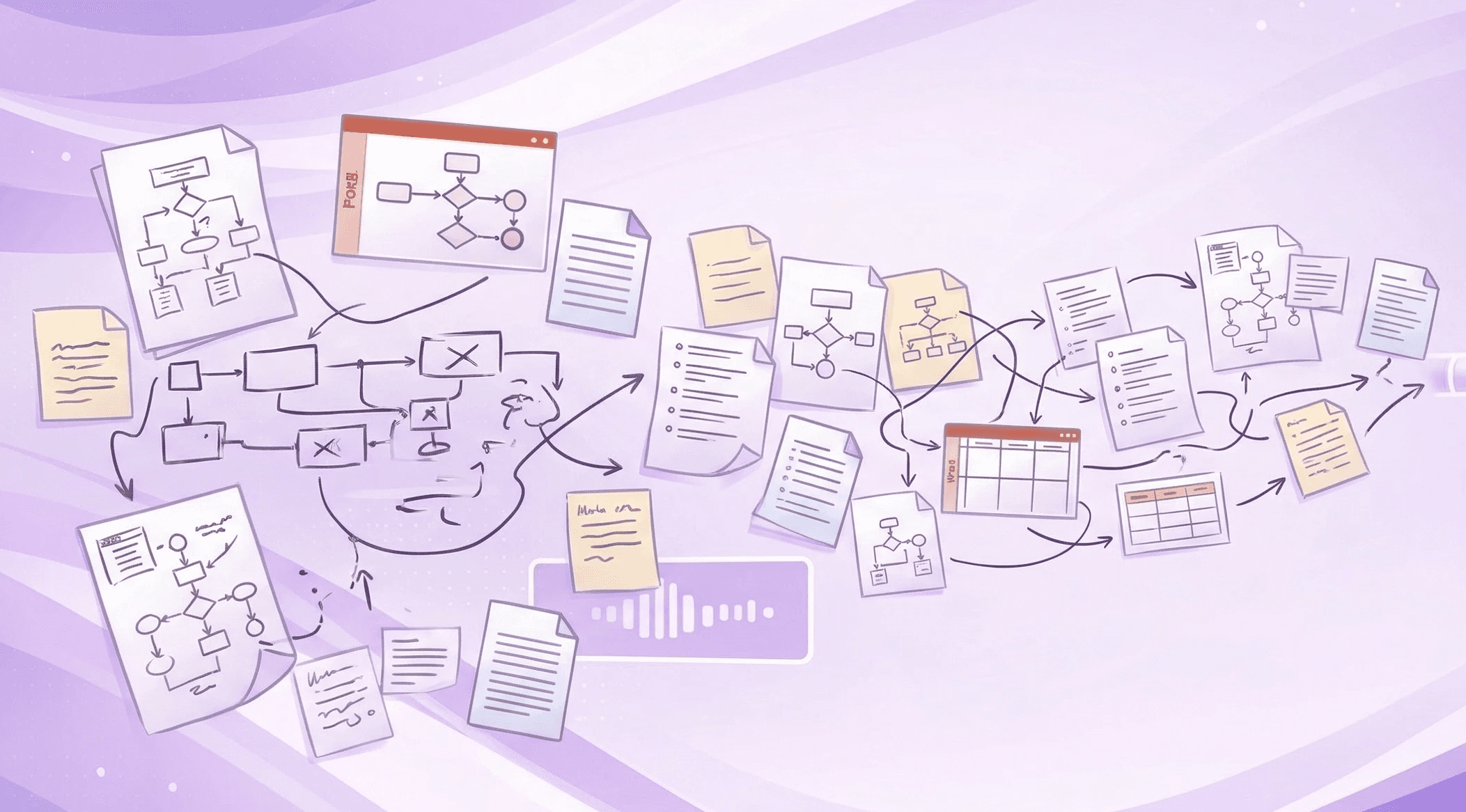
If your "process models" are flowcharts drawn in PowerPoint or Visio without following any standard, you are building on sand. These diagrams cannot be imported into professional BPM tools, cannot be validated automatically, and often mean different things to different people. A rectangle in one deck is a decision point in another.
The fix: adopt BPMN 2.0 as your standard. It is the global language for process modeling, supported by every major enterprise tool. If your team needs a shared baseline, start with what BPMN is. With ModelMatic you can generate diagrams straight from a recorded conversation, no manual drawing required.
2. Nobody trusts the current documentation
When stakeholders say "that is not how we actually do it" about your process models, you have a trust problem. This usually happens when documentation was created once and never updated, or when the people who drew the diagrams did not fully understand the process.
The fix: involve stakeholders directly. Record the interview, generate the diagram in the session, and validate together on the spot. When people see their own words reflected in a professional model, trust follows naturally. Correcting a picture is also far easier than reviewing pages of prose, so you get better feedback.
3. Every analyst delivers different quality
One analyst creates detailed, well-structured models. Another delivers high-level sketches that miss critical decision points. This inconsistency makes your process architecture unreliable and hard to compare across departments. It also means quality depends on who happened to be staffed on the project.
The fix: standardize the modeling process itself, not just the notation. When AI handles the translation from conversation to diagram, the output lands in the same structure regardless of who ran the interview. Your experts then spend their time on judgement instead of layout.
4. Modeling takes weeks instead of days
If a single process model requires multiple interview rounds, weeks of drawing time and several revision cycles, your approach is too slow for today's pace of change. By the time the model is finished, the process may have already evolved. Worse, a model that expensive never gets revisited, even when everyone knows it is wrong.
The fix: compress the cycle. With AI-assisted modeling you go from interview to validated diagram in a single session. That changes what you can afford to document, including the regional variants and exception paths that normally get waved through as standard.
5. You cannot connect documentation to automation
Modern organizations want to move from documentation to automation without a detour. But if your process models are not in a standard format, there is a manual translation step that costs time and introduces errors.
The fix: start with BPMN 2.0 from day one. Models created in this standard can be imported directly into automation platforms like Camunda, SAP Signavio or Celonis, bridging the gap between understanding and execution. This matters more every quarter, because AI agents need an explicit, machine-readable process definition before they can safely run any part of a process.
How to check where you stand
A quick audit takes an afternoon. Pick your three most business-critical processes and ask four questions about each:
Can you open the model in a tool other than the one that made it?
When was it last changed, and does that match the last time the process changed?
Does it show the exception paths, or only the happy path?
Could an engineer hand it to an automation team without redrawing it?
If you answer no to two or more on any process, that process is where your upgrade should start. Decision points are usually the weakest part, so BPMN gateways are a good place to look first.
Ready to upgrade?
If you recognized your organization in any of these signs, it is worth rethinking your approach to process documentation. ModelMatic helps you create professional, standardized process models in minutes, so you can focus on improving processes instead of drawing them. Book a demo and bring one process you already know well.