AI & Process Discovery
Process mining vs task mining: what each one misses

Robbert Schuurmans
Process Innovation

Process mining, task mining and a screen recording in which someone explains the work are three ways to find out how a process really runs. Process mining reads the event logs of systems, task mining installs software on employees' computers that logs their clicks and a narrated recording shows one person doing the work and saying why. They answer different questions, at very different cost.
Consultants hear the question more and more. A client has read about process mining and asks whether it would help. Often the honest answer is: not for this project. The clearest way to show why is to follow one ordinary process through all three.
One invoice, five steps and one rule
Sanne works in accounts payable at a wholesaler. An invoice comes in that does not match the purchase order. She handles it like this:
The invoice arrives in the ERP.
She compares it with the purchase order and the goods receipt.
She checks the agreed price in an Excel price list.
She emails the buyer about the difference.
She approves and books the invoice.
And there is a rule she has never written down: a difference under €50 she accepts without asking. Only above that does she email the buyer.
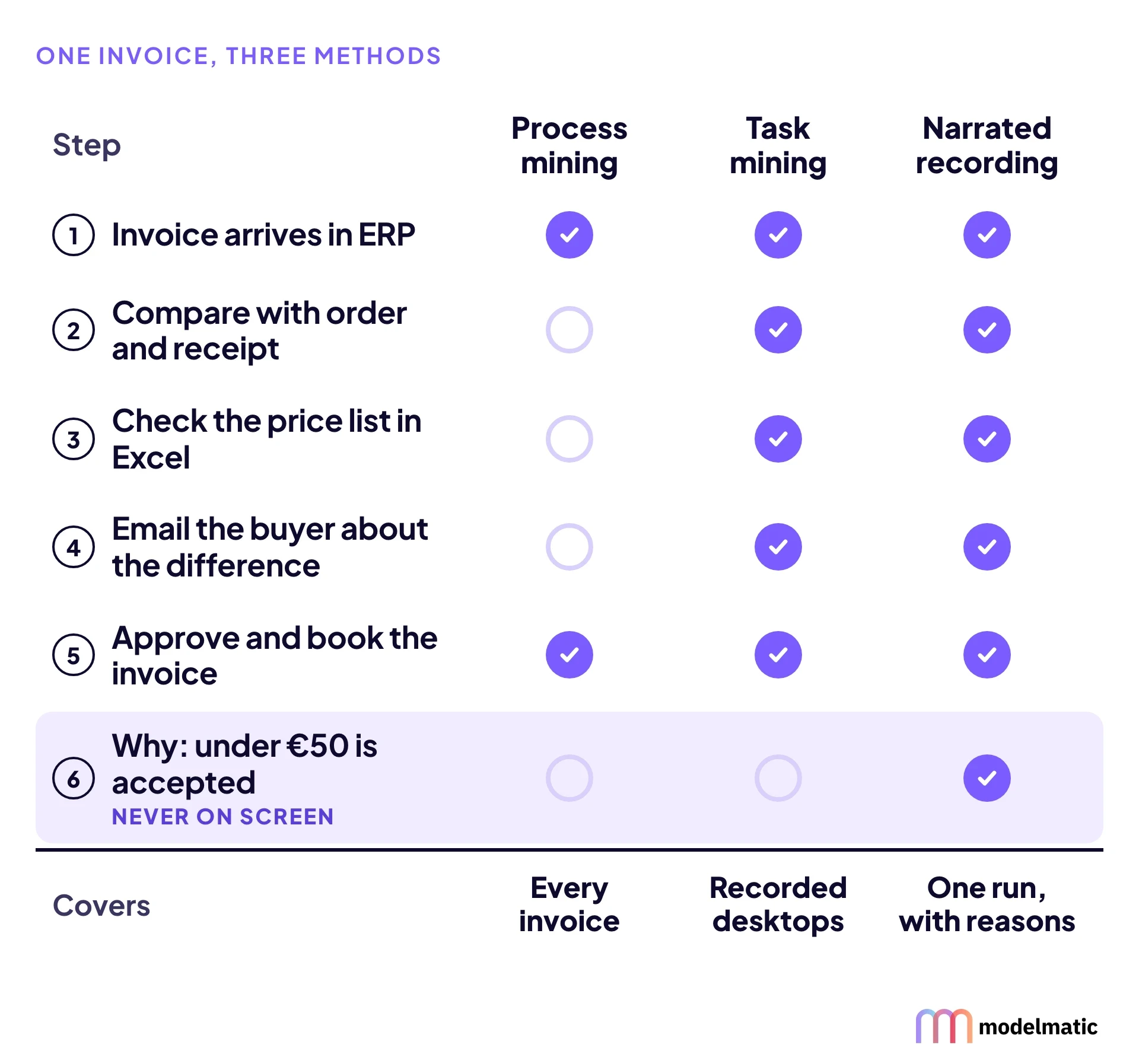
Every step happens on screen. The rule that decides between them does not.
Process mining: for volume, after a data project
Process mining reconstructs processes from the event logs that systems keep. Every time an invoice is registered, approved or paid, the ERP records it with a timestamp. Give process mining hundreds of thousands of those records and it shows the process as it actually runs: every variant, every loop, every wait. The field has grown with tools such as Celonis and with research from the IEEE Task Force on Process Mining.
That is also where it belongs: large volumes, many cases and a process that runs mostly through systems. In Sanne's invoice it sees two events, received and booked. Across a hundred thousand invoices that is exactly what you want to know: which suppliers cause the most mismatches and where approval waits.
The catch is the work before the first chart. An ERP does not keep a ready-made event log. Every event needs at least a case ID, an activity name and a timestamp (Microsoft lists the same minimum), and that data is spread over dozens of tables, sometimes across several systems. Someone has to extract it, link it and clean it. Researchers estimate that this preparation takes up to 80 percent of the time in a process mining project.
For a process that a handful of people run a few hundred times a month, or for a consulting assignment of a few weeks, that sum rarely works out: the data project costs more time than the analysis saves. And even when it is done, the log does not show the Excel check or the €50 rule. It shows that some invoices take three days longer, not why.
Task mining: an agent on every desktop
Task mining comes from the automation world. Tools from UiPath, Celonis and Microsoft install a recorder on employees' computers. It logs clicks, keystrokes and switches between applications, often with screenshots, usually for a small group over a set period. An administrator decides which applications are recorded. Machine learning then groups the actions into tasks and shows which ones repeat and how long they take. The goal is to find work that a bot could take over.
In the invoice, task mining sees all five steps, including the lookup in Excel and the email. It notices that Sanne opens the price list forty times a day. What it does not see is the rule. It sees that some invoices lead to an email and others do not, but not why.
The setup has a price. Software has to be installed and watch while people work, which in many European countries needs the agreement of the works council. And what comes out is clicks and tasks, not a process model you can discuss with the business.
The gap ModelMatic fills: the steps and the why
Process mining and task mining leave the same gap. Neither tells you why the work goes the way it does, and both need a project before you see anything. That gap is what ModelMatic is built for.
Sanne records her screen while she handles a few invoices and talks through what she does: "I check the price list here, because orders often carry last year's price. Under fifty euros I let it go, above that I ask the buyer." Nothing has to be installed on her computer and nothing watches along: she decides what to record.
ModelMatic turns that recording into a process model. The AI uses what happens on the screen and what Sanne says together. The result is not a list of clicks but a BPMN 2.0 model at process level, with the decision she explained in it.
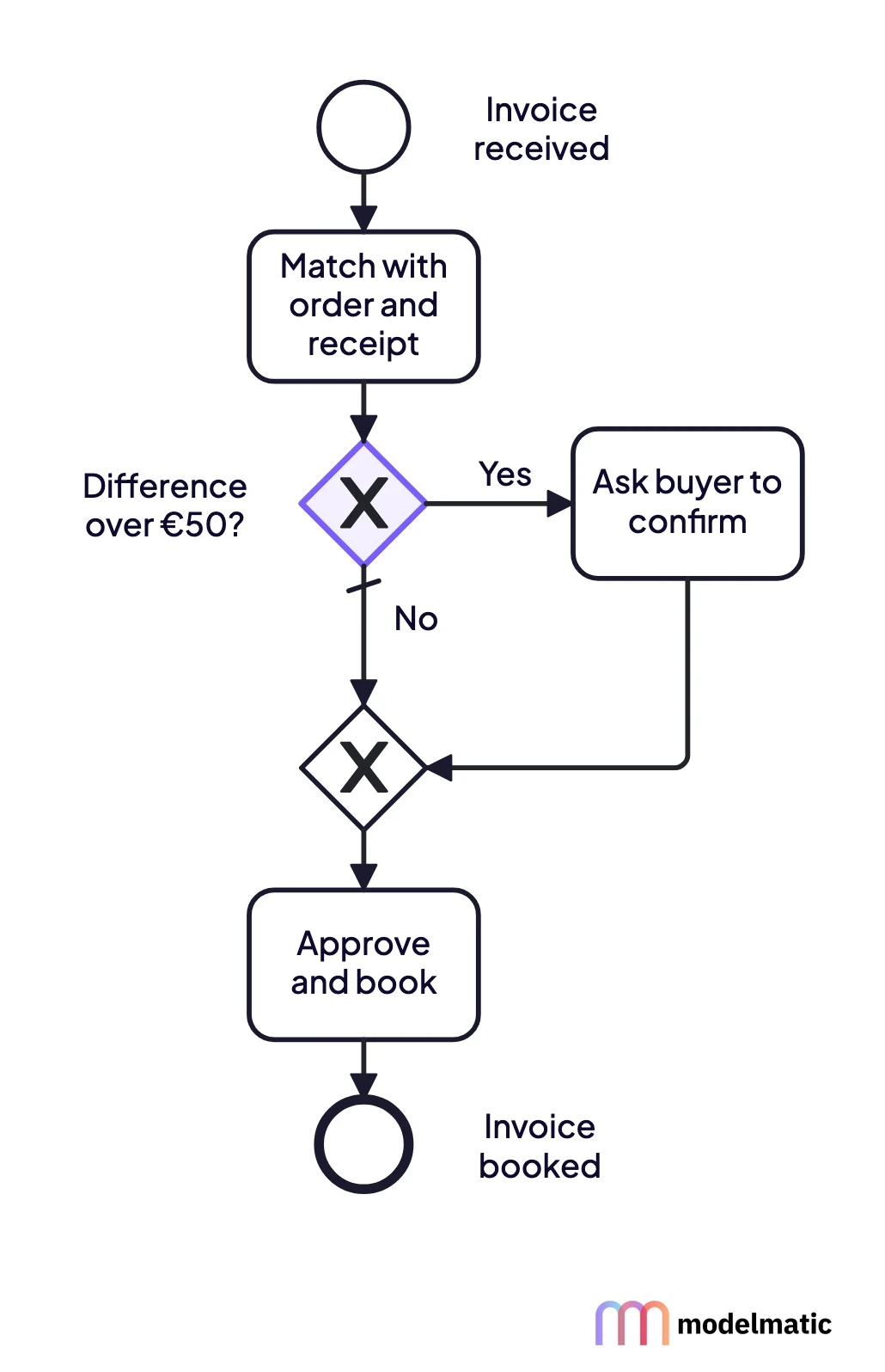
The highlighted decision comes from what Sanne said. No click and no log reveals it.
Next to the other two methods, that means:
No data project. You do not extract, link or clean event logs. A recording of a few runs is enough to start.
No agent on anyone's computer. Nothing is installed and nothing runs in the background, so it does not raise the monitoring questions that task mining does.
The why ends up in the model. Rules that only live in someone's head, like the €50 limit, become decisions your team can see, discuss and validate.
A model the business can read. A BPMN 2.0 model at process level instead of thousands of clicks, with a BPMN 2.0 XML export that you can import into tools such as SAP Signavio, Camunda and Bizzdesign.
The limit is that you see how Sanne does it, in a few runs. Whether her colleagues apply the same rule you find out with more recordings, a few interviews or, at enough volume, with mining.
Which method fits which question?
Where does our process get stuck, across tens of thousands of cases? Process mining, if the volume justifies the data work.
Which repetitive work could a bot take over? Task mining. It measures clicks and time across many desktops, which is exactly what a business case for automation needs.
How does this work actually get done, and why? A narrated screen recording or a good process interview. Fast, no IT project and no agent on anyone's computer.
Combining them often works best
The methods do not exclude each other. A sensible order: first capture how the work is done and why, with recordings and interviews. Turn that into a model and validate it with the team. Then, if the volume and the question call for it, measure with process or task mining.
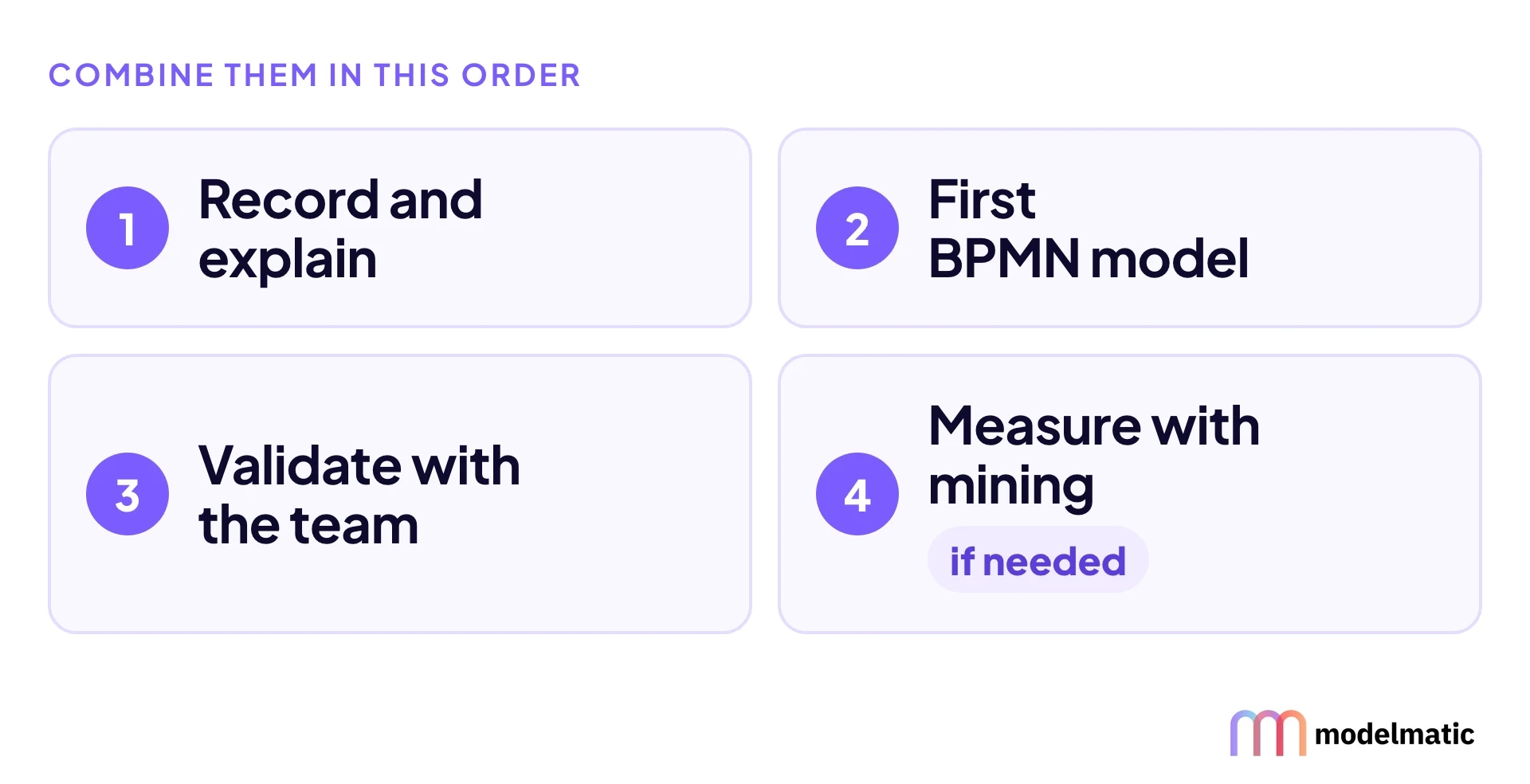
Know what the steps mean before you measure them.
Starting with mining without knowing the work leaves you with a diagram of hundreds of variants and no idea which ones matter. In the invoice, mining shows that some invoices wait for an email. The recording tells you it is the €50 rule and that outdated prices on orders are the cause.
For consultancies, the first step is where the hours go: capturing, working out, validating. That is where a recording that turns straight into a model saves the most. Florinet, a supplier of ERP software, records its client conversations and saves four to five hours per process with every new client (read the case).
Try it on one of your own processes
Screen recordings are in beta in ModelMatic. We do not switch the feature on for every account yet, but you can try it on a process of your own:
Book a demo and tell us which process you want to try it on.
We show you how it works and switch the beta on for your account.
Record that process once on your screen while you explain what you do and why, upload it and validate the model with your team.
Pick a process that runs mostly on screen and has a few rules nobody has written down. That is where you will see the difference fastest.
For background on process mining as a field, see processmining.org.